

Team-up with LinkedIn’s Top Coach to Own Your Career and Life!

today’s world of AGI, agentic workflows, and robotic automation, careers are changing rapidly. Managing your own career in this flux requires navigating expertise that you cannot develop on the fly. Trial-and-error is not the best approach to career management—especially now—as the speed with which the context is facing ground-shifting change does not allow for the time that each cycle takes to learn from these trials.
Besides, just one setback in this cycle can create a downward spiral that will make it difficult to recover as you notice your peers passing you by. Career management is a codified discipline that requires you to be in the arena, not in the bleachers. To manage this sea change will require going back to the basics, yet, acknowlegdeing the reality of what it takes to navigate through these troubled waters. An expert coach—like a guiding lighthouse—can now beacon your path to navigate your career progression in ways that cannot be expressed in simple terms; now you can prevent crashing your career by avoiding the sudden dangers that lurk in these troubled waters. It can transform how you face your own reality despite your past and how you’ve been unable to actualize your superpowers. In the process you may even uncover your own new superpowers!
So, How to Exploit this Opportunity?
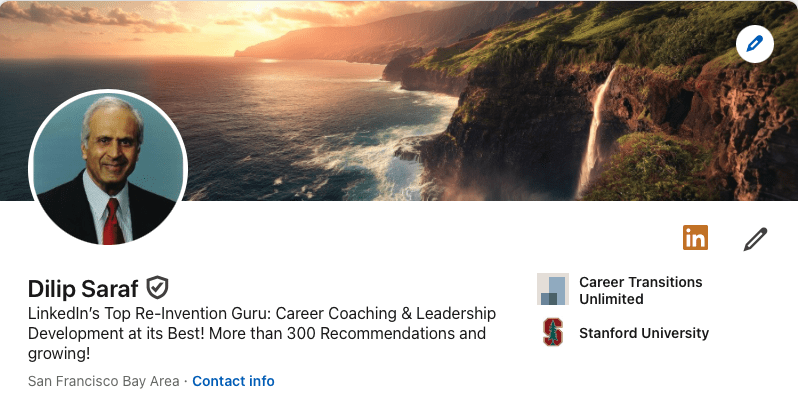
Come! Team-up with a renowned career coach, who has reinvented himself through five careers in five different industries and has codified that wisdom helping more than 8,000 clients in 24 countries uncover new ways to find fulfillment in their endeavors. If this interests you then you’ve come to the right place to understand and to practice the secrets of career management.
As head of engineering at a large high-tech conglomerate and as director of programs at a major aerospace company, Dilip Saraf has codified what it takes to manage a career not just for greater responsibility and status but also for your own fulfillment. Many pursue the former as these trappings are tempting. In the process they surrender their soul’s needs to nurture, sacrifice their health, personal priorities, and a balanced life, often burning out as they struggle to keep up with the endless demands from their workplace. This vicious cycle only gets worse with time until something breaks or badly gets hurt; often their soul! A fulfilling life can be achieved by an increasing alignment among these four elements: Your body, your soul, your mind, and your material needs. Breaking this pernicious cycle takes awareness, action, and commitment.
Come, break this cycle and find joy and fulfillment in what you do, getting energized by how you do your work, nourishing your very soul. When you do this you’re riding a virtuous cycle. Of course, getting to this stage requires changing the way you engage in your work and knowing how to make that change is the secret to success. You’ll learn during the coaching process that many of these changes are counterintuitive, but they become obvious as you start internalizing them and seeing the results of your efforts. Once they become part of your being, you are transformed.
I became LinkedIn’s top coach—from among the millions of coaches now on LinkedIn—not by accident, but by applying what I learned during my reinventions to help my clients. They range from new college graduates (NCGs) to C-levels—and I show them how easy it is to stay on top of their game once they start practicing these time-proven, wisdom-driven practices. Read through more than 300 signed Recommendations [LinkedIn ranked coaches based on the number of Recommendations] on my LinkedIn Profile to learn how these clients used my proven methods to propel their careers in ways that worked for them. Come, work with me to know the secret to this way of managing your career and your life and see how easy it is when you “get it.”
Barriers to Taking the Leap
So, despite the positive benefits of engaging an expert career or executive coach it is not so obvious what the obstacle to this is. The simple answer, Unconscious Incompetence: most professionals maunder through their careers—and life—in a state of blind ignorance and let their career happen to them. The pernicious price most pay for going through their entire work-life in this state is incalculable.
An expert coach can help you move from unconscious incompetence to conscious incompetence. Here, you know what is missing. With some guided work the coach can steer you on to operate now in a changed state of conscious incompetence, which forces you to get out of its clutches. Once you reach this awakened state this coach can then take you towards conscious competence with the guided work that you must do.
In this state of conscious competence, you now have much better control over your career—and above all—deriving joy from how you engage in what you do, a state of being, not just of doing.
With ongoing work—mostly self-work—you can even achieve the ultimate state of unconscious competence—a state of bliss; right things flow your way as a matter of what you pursue. Remember, pursue also means to attract!
Yet another barrier is the perceived cost of working with an expert coach for those unemployed in a tough job market. Here, too, trial-and-error can be highly demoralizing!
So, regardless of what state you’re in—working or looking for work—seek the expert help you need to get yourself on a path that rewards you just by changing how you approach your life’s curveballs and realigning how you face your career and life challenges. See how easy to work in the flow state!
The Power of Great Storytelling
Great storytelling is one of the most enduring and universal communication forces. Long before data, stories shaped how people saw the world, made decisions, and connected. The power of a well-told story lies not only in its ability to inform but in its ability to transform—emotionally, intellectually, and behaviorally.
Storytelling was codified in Aristotle’s Poetics—a work of dramatic theory—published some 2,500 years ago, yet it is fresh today as it was a breakthrough then. Its six-element codified storytelling structure is as powerful today for magical storytelling—be it a movie, a drama, an opera, a novel, even your résumé and your bio—as it was then!
At its core, storytelling—it is data with a soul—organizes complexity into meaning. Data alone can overwhelm; stories bind those facts into a clear arc that helps audiences why something matters. Your good leadership narrative can give people a sense of direction—who the characters are, what they want, what stands in their way, and what’s at stake—all synthesized with those six story elements. This structure triggers the brain to engage more deeply for meaningful action.
Emotion is another central lever. Humans are wired to respond to tension, empathy, surprise, and resolution. When a story evokes feeling, it bypasses analytical filters and connects directly to intrinsic motivation. Leaders use stories to shift mindsets, build trust, and galvanize action —because people don’t commit to ideas; they commit to their meaning.
And yet, we suck at storytelling! Just imagine how different your résumé, bio, LinkedIn profile, and interview performance can be if you just knew how to build your leadership narrative crafted around your own success stories!
Storytelling also humanizes the storyteller. It signals authenticity and vulnerability—qualities that strengthen ethos. Whether in a business context or in a personal setting, such as job interview, stories remind audiences that decisions aren’t made just by spreadsheets but by people with hopes, fears, and aspirations; by leaders who can affect change.
Finally, great stories inspire movement. They clarify values, spark imagination, and invite others to see themselves as heroes. Done well, storytelling transforms communication from a dry transfer of information into a richly shared experience—one that aligns people around a purpose and makes the message unforgettable.
In a world overflowing with data and noise, the ability to craft and deliver meaningful stories is not some esoteric gift—it is a strategic advantage, a force multiplier—your superpower.
The Storytelling Magic in Executive Leadership
Not just for executive leaders—but for anyone—storytelling is not just another soft skill—it is a sine qua non. In environments defined by increasing complexity, competing priorities, and constant change, the ability to articulate a clear, compelling narrative often determines whether a strategy is merely understood or deeply believed. Great storytelling converts leadership intent into organizational energy.
At the top, datapoints, metrics, and dashboards describe what is happening; a story explains why it matters and where we’re going. A well-crafted narrative frames a strategic choice, aligns stakeholders, and connects daily actions to a broader mission. Leaders who talk through stories help teams see patterns, anticipate challenges, and stay anchored even in uncertainty.
Storytelling also enhances executive presence. It humanizes leaders in moments where authority alone is insufficient. By revealing the values, tensions, and trade-offs behind decisions, stories create transparency and trust—two prerequisites for influencing at scale. When leaders share authentic narratives about past failures, hard-won insights, or defining moments, they model courage and create psychological safety organization-wide, engendering trust in all.
Come, learn how to tell your own great story. Well-crafted stories create a visual narrative in a reader’s mind to spark compelling action!