


With the sudden explosion of AI-driven solutions, everyday software companies are now caught flatfooted as their value to the traditional industries has imploded, evidenced by their decimated stock prices during the past few months. This New York Times article describes their plight well and focuses on how they are trying to rebrand themselves—many with new slogans and PR stunts—to be seen as belonging to the AI-native realm; some are even changing their company website domain from “.com” to “.ai,” without making any basic changes to how they do their business.
Most of the well-established software companies are now facing an existential crisis. And that existential crisis has spawned an identity crisis: software companies at every stage — from start-ups to publicly traded corporations — have been working hard to be seen as A.I. native companies. The reason for the panic is clear: over the past 12 months, software stocks have seen their biggest plunge in more than 30 years, wiping out $2 trillion of market capitalization from the peak, according to J.P. Morgan. The S&P North American Expanded Technology Software Index has dropped about 20 percent in just the past month. And shares of the software giants, Salesforce and ServiceNow are down more than 40 percent over the past year.
In their moment of panic most companies have become reactive and gone into their default fire-fighting mode. Many still have armies of engineers and support staff that they want to unleash to make an appearance of concern to their confused customers and give them something to alley their concerns, not with right, new solutions, but with paying lavish attention to their plight. In my view this is backwards!
Why?
What these confused companies have failed to realize is that they are now facing a paradigm shift in how their customers’ organizations are transforming their operations in the wake of this emergent A.I. wave. They also realize that this new way of doing things with A.I. is the future and is not just another fad. Their focus has now shifted on workflows, which was previously on siloed functional areas. The solutions and processes the software companies provided to their customers were fashioned fit the old paradigm and now trying force fit their “AI-branded” solutions into the plastic moment their customers facing today is only going to create more confusion in their customers’ minds, creating further alienation and brand erosion.
So, what is the alternative to moving forward with confidence instead of embracing this brute-force and “trial-and-error” approach to getting once again customer focused?
The obvious and most direct answer is to start with the confused customer!
By this I mean instead of unleashing an army of engineers and providing their customers what is unlikely to work for them long-term, the right approach is to develop a new relationship with your existing customers and spend your energy and efforts on understanding their pain points and anxiety around how they themselves need to become an A.I. company. Here, you are going in as an expert A.I. solutions provider, and you are going to do this through an engagement with your customer in an entirely new way. The following diagram describes the process of this can work. This design is based on a relationship engine, which consists of three simple elements: Discovery, Action, and Experience with a feedback loop. If the discovery and action result in an improved customer experience it invites further discovery, creating a flywheel of virtuous cycle.
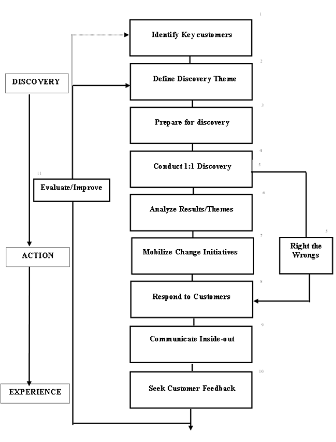
Fig-1: Customer Discovery Process (Adapted from Quality on Trial-McGraw Hill)
The remaining part of this blog will describe some of the major elements of this process and what a company needs to do to reengage their existing customer base in a new way:
- Identify Customers: The overall process of discovery and action involves—first and foremost, a mindset shift—resources, time, and making a commitment to improve things. In view of this, the selection of customers who will be party to this process must be done with a studied approach. Using the 80:20 rule is generally a good guideline. This means that 80 percent of the change can be affected by doing a discovery with 20 percent of the customers who are critical to your business. If this process is handled correctly, participation is nearly 100 percent. By contrast, participation in surveys is less than five percent. To make matters worse, those who participate in surveys are outliers on either side of the normal distribution (deviants). What this means is that those that are extremely satisfied or those that are extremely dissatisfied tend to dominate the participant pool. The most important pool, the one that lies in the middle of the distribution, rarely participates. An additional consideration¾and an important one¾is the actionability of the captured data.
- Define Discovery Themes: Once the customer pool is identified, they share some common features. Using these features, and the intent of the discovery, it is a good idea to design a set of queries that will be used in the discovery. Not all discovery designs are identical, but in a pool of customers carefully identified, there is a common element. Each discovery for a segment of customers within a pool may have variations beyond the core design. This allows for a rich, and yet standardized, discovery, which helps in data analysis of themes and comparisons.
Most companies convince themselves that they already talk to their customers in a variety of avenues: new product features, escalations, customer support, sales calls, and other everyday obligations. This is exactly the problem. In a transactional exchange the information you get is also transactional and not strategic. In the context of this discovery the questions you ask and the discussions you design beforehand are highly strategic that can redefine your next round of customer relationships. - Prepare for Discovery: Preparation entails identifying how to match the customer/ interviewer pairs and then training those who are going to go and conduct face-to-face meetings with customers. A good design is two employees per customer. Each of the employees must have some connection with the account, as well as the customer being interviewed. Their prior training is critical, because how to ask questions, how to dig deeper for specific information, how to be non-judgmental and non-defensive are some of the key elements to learn during this training. The more non-defensive a discovery is, the richer its outcome, and the more strategically actionable its content.
- Conduct 1:1 Discovery: This step entails a pre-selected pair of employees going to the customer site and meeting with the customer to conduct the interview. This is organized by first briefing the customer well ahead of time, explaining what the process is about, and most importantly the benefit to them. Typical requests may entail asking for about 45 minutes for such a meeting and then seeing how it goes from there in an actual setting. A well-designed and executed interview and discovery can result in a customer spending much more time than originally scheduled. This is usually a good yardstick for its success at this stage.
- Righting the Wrongs: This is a very critical step in the process. In step-4, for setting up the interview, customer benefit was the centerpiece of this request. This step is how it is immediately demonstrated. What this entails, then, is that if a customer has an urgent matter that relates to something that has gone awry in the recent past, it will come up during the interview. Probing further to explore what will allay the pain so caused, as well as what measures can be taken to band-aid the situation, are critical to the customer experience, and to also demonstrate good faith for the discovery process. Immediate and specific interventions are two of the most important factors in this step. A follow-up after the remedy is also a good step.
Although this step is critical to establishing your good-faith intent for the discovery process, it is there to provide customer some sense of action on a particular and pending issue. The real core of the customer input is much more strategic and long-term. - Analyze Results/Themes: This is where the entire pool of data across the chosen population of clients is aggregated, analyzed, interpreted, and made actionable. Themes are identified and grouped. Specific actions by each customer type/category are then separated out under each theme so that the changes resulting from the action are specific to each account for which the discovery was conducted.
- Mobilize Change Initiatives: Once the data is converted into actionable interventions that define a change plan, it is time to present it to senior management who can agree on the priorities and scope the change. This change may be structured in a phased manner to address the priorities emerging from the curated change themes that emerge from the discovery. Assignments of specific responsibilities, including communication, are then made at this stage.
- Respond to Customers: This is where the change actions get specific to each account and the major change initiative agreed to in Step-7 is actualized for that account, and specifically, that customer.
- Communicate Inside-out: Communication is the most critical element of the entire process. Who communicates what to whom and how this is done, and when, are all very important in maintaining the original spirit of the discovery.
- Seek Customer Feedback: This is the Experience part of the Relationship Engine. At this stage, customers are asked specifics about what worked and what needs work and why. If the Experience is positive, there will be an invitation for further discovery¾a good sign of an improved relationship.
- Evaluate/Improve: This is the final step that allows ongoing improvement of the process and making changes based on the learning from the previous discovery.
On its face, this process and approach may seem banal and wasteful. The common reasoning is that most companies have strong relationships with their customers. What is missing from those interactions, however, is that they are designed to push more sales and services to the customer. In this approach, based on customer discovery, designed to elicit strategic input the outcome and impact are very different because they are based on a different mindset and design.
In my own experience, which stretches over six years of working with companies like Hewlett-Packard, IBM, Goodyear Tire & Rubber, and many other F-100s this discovery process fundamentally changed how these companies re-engaged with their existing customers and greatly improved their customer standing and their relationships with them. Good luck!
